
Getting Back Into the Swing of Things
Well that was a shit offseason…

Post-UTMB it was always the plan to take some time off. Some proper time off. You’d even go as far as to call it an off-season. I had grand plans to make the most of it. To get into the water diving or to head into the hills for a mission before baby Hudson arrived.
However, even the best-laid plans sometimes don’t go to plan, and mine are usually only half pie anyway. I got sick when I got home and just couldn’t shake it. The weather was rubbish as well, so there were quite a few days of just chilling out. Then Hudson came along, sleep was heavily reduced, and I thought that seemed like a decent time to get back into some training, as much to keep a bit of sanity with everything going on.
So post-offseason, let’s talk about how I went about getting back into it.
I’d be lying if I said it’s all been going smoothly. The standard aches and pains have shown up as I’ve eased back into training. A bit of a tight ITB, and tight calf muscles, but nothing debilitating.
And, a positive thing here is that I’ve really been leaning into training to feel, concentrating on quality rather than trying to ramp up the training load too quickly. I’ve enjoyed getting out on the mountain bike (on the odd fine day) and putting a big focus on my strength work.
The strength is what I really wanted to touch on today. Strength Work in the Base-Building Stage
I think this part of training is so important, especially to work out any niggles and to build a solid foundation for the season ahead.
Before Western States and UTMB, I worked with Marcos from Rehab Physio - Thorndon clinic (Rehab is Wellington and Auckland-based) on a fairly ad-hoc basis, but with plenty of exercises to keep me in one piece focusing on the maintenance phase. However, we’d made a plan to really kick things off properly after UTMB.
Now here we are.
When I got back, we chatted about what I felt needed work and did strength testing of muscle groups using a handheld dynamometer to measure force output. With those strength scores, we could identify imbalances and areas to focus on. From there, Marcos made me a plan.
Once a week I’m training at my home gym, and once a week I’m at the Rehab gym where Marcos puts me through a full circuit, pushing close to full exertion. After these circuits, I finish things off with blood flow restriction bodyweight squats.
It’s the first time I’ve tried these, and I wanted to share a bit more on what’s actually going on.
The idea behind Blood Flow Restriction (BFR) is pretty simple: you apply a cuff or elastic band high on the limb to partially restrict blood flow out of the working muscles.
You’re not actually cutting off all the blood flow. It’s more like you’re slowing it down. Blood can still get into the muscle, but it can’t get out as easily. That trapped blood makes the muscle work harder to move and recycle oxygen, which tricks your body into thinking it’s lifting something really heavy, even though the weight is actually pretty light.
Essentially, you get a heavy workout stimulus without the heavy weights.
It’s brilliant for phases where you want to build strength and endurance without adding too much mechanical stress to the joints. Perfect for rehab, offseason work, or when returning from a big race block.
After Marcos’s circuits, I’ll throw on the cuffs and do several sets of bodyweight squats to failure. The burn is intense, but I’m not getting that same deep DOMS (muscle soreness) the next day.
Research backs this up. Low-load BFR, even bodyweight like what I’ve been doing, can still trigger strength and muscle growth similar to traditional heavy lifting. The key is getting the pressure right: tight enough to slow blood return but not so tight that you block blood flow entirely.
If anyone’s curious about trying it, it’s worth doing your first few sessions under guidance. Get someone experienced (like a physio or strength coach) to help find the right cuff tightness for you, it’s a fine balance between effective and overdoing it. Mine was set to 80% of limb occlusion pressure. I’m not too sure what that means, but Marcos worked the controls and I followed orders!
Within my full workout, some of the exercises that I find super helpful yet extremely challenging (I won’t go into every exercise) are:
Single-leg sit-to-stands (holding 20kg) - this one was a bit of a fail on my right leg but just manageable on my left
Single-leg RDL to box step-up with a 20kg barbell, focusing on an explosive stand
Then finishing with those BFR squats absolutely ruins me.
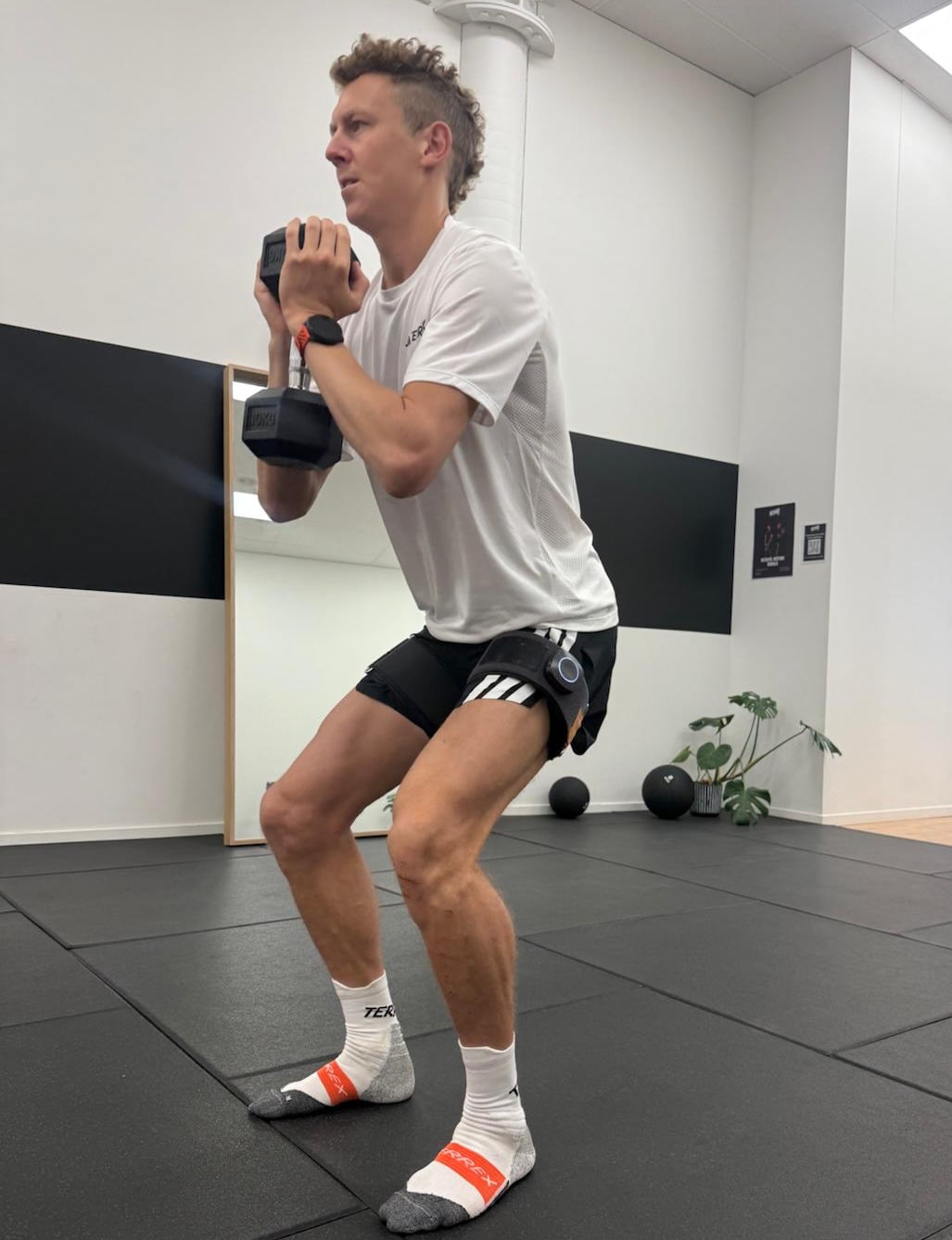
I come out of it a sweaty mess, but feeling better for it. Already I’m noticing the difference, this strength work combined with getting back out on the trails is helping the fitness and rhythm of running return. And more importantly, I’m building a stronger, more robust base for the big goals ahead.
This brings me to the next goal…
If you missed it on Instagram, I’ve signed up for the GPT 100 Mile Stage Race, taking place on the 6th, 7th, 8th, and 9th of November in Halls Gap, Australia.
It’s going to be an incredible challenge, and in the next article I’ll share more about why I chose it, and how it’s shaping my mindset heading into the new season.
As always appreciate the support! If you’re new here, hit the link below to receive fortnightly Substack’s straight to your email. If you have a topic you’d like me to discuss and expand on, please let me know in the comments below or via DM on Instagram.
Let’s work together to keep taking trail running forward
DJ
Great to read a detailed post about off season and majorly about focus on strength training and what major role it plays our in an athlete's journey.